
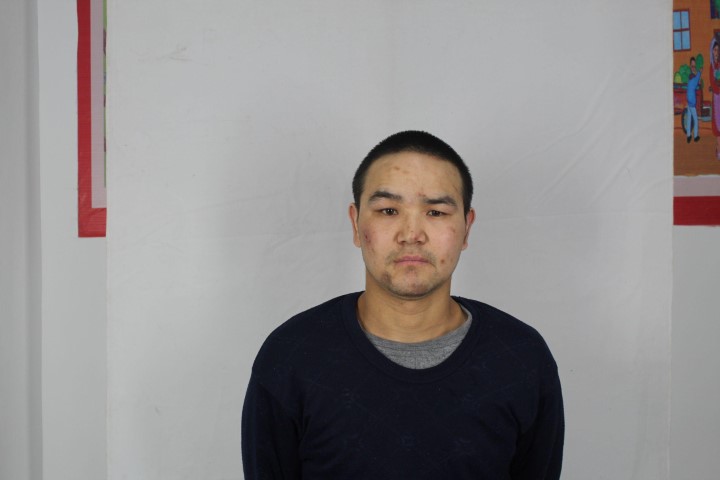
This is a summary of a short study on bruises in the Xinjiang Police Files photos, comparing the thousands of photos for detainees with thousands of photos for non-detainees to see if there are substantial differences. The result is anticlimactic – no conclusive differences are found – but we report it anyway, in case others want to revisit this topic in the future.
The regular use of violence in detention, both in punishment and interrogation, has been reported in the vast majority of eyewitness accounts from Xinjiang. In an attempt to corroborate this forensically, the Xinjiang Victims Database analyzed the thousands of photos from the Xinjiang Police Files for evidence of skin discoloration, so as to identify potential bruises and to see if they featured more prominently in detainees. Specifically, we looked at the images of 2522 individuals reported as detained in other files and compared them to the images of 2115 individuals with no known record of detention.
To screen for possible bruises automatically (instead of going through all 4600+ photos manually), we first processed all of the images to extract the relevant skin only (ignoring the ears, eyes, eyebrows, hair, mouth, nose, and neck) and gave each extracted pixel a normalized “darkness score” (D, between 0 and 1) based on its RGB value:
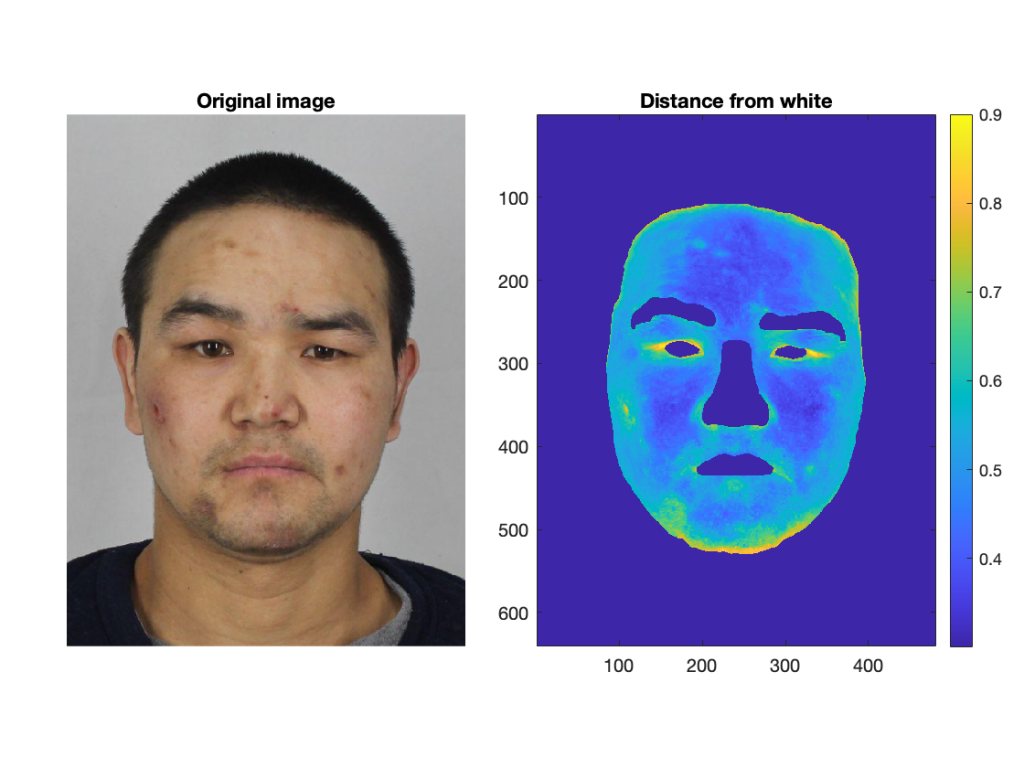
where a pixel with R=0, G=0, B=0 is pure black (maximal darkness, D=1) and one with R=255, G=255, B=255 is pure white (minimal darkness, D=0). To illustrate the procedure, we borrow the photo of Sidiq Tash, an Uyghur man who was detained in mid-2017 and photographed around 6 months later, and who has very clear bruise marks on his face.
The following comparison shows the pixel-darkness analysis, with darker skin regions appearing in yellow or green and the lighter ones in blue:
To identify bruise candidates for all 4600+ individuals, we then wrote a custom code that searched for any connected regions that were darker than average. Because lighting effects, wrinkles, large moles or acne, ruddy cheeks, and facial hair can also create darker regions and generate false positives, we had the code remove the following areas from consideration:
- dark regions on the perimeter/edge of the face (often due to lighting, as well as facial hair on chin);
- dark patches around the nose, mouth, eyes, and eyebrows (often due to lighting, and since bruises are less likely there);
- dark regions that are symmetric with respect to the center vertical line, suggesting natural traits (such as ruddy cheeks, wrinkled areas, or facial hair), while bruises are typically asymmetric;
- dark regions that are too small (likely acne or moles);
- dark regions with elongated geometry (often wrinkles, since bruises are expected to be more ellipsoidal or round).
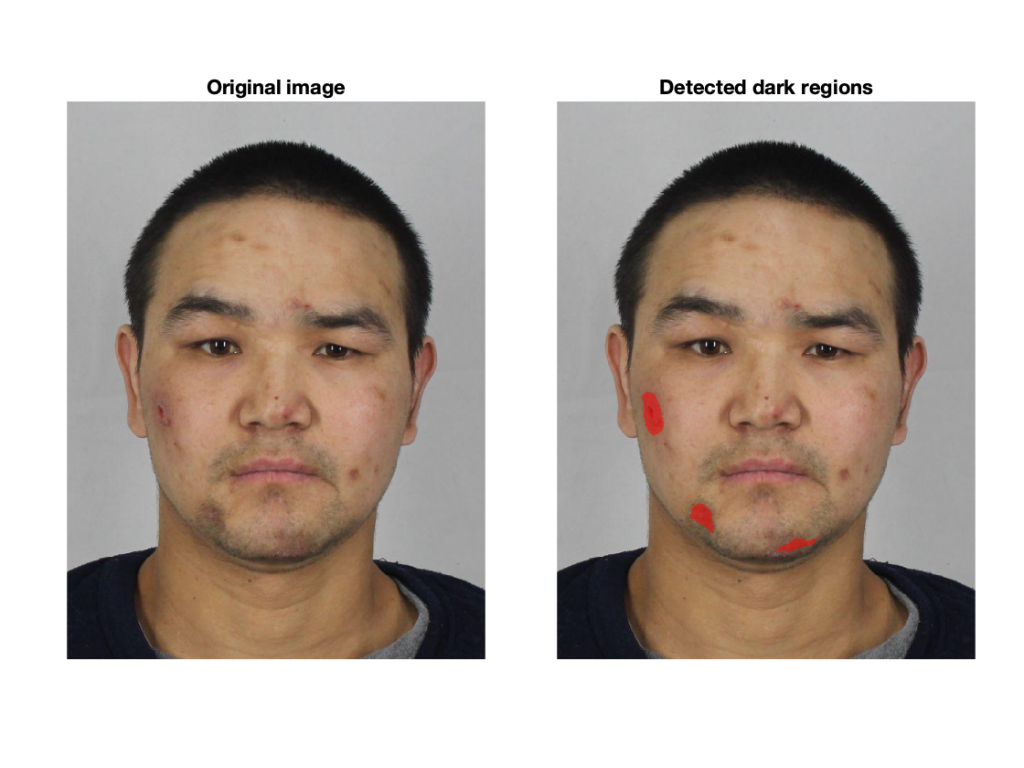
We then tuned the actual parameters on a small test set, which included Sidiq Tash, so that the code correctly identified the three major bruised regions for him (cheek, side chin, lower chin) without returning any false positives for the others.
The outcome for Sidiq is shown below:
Running this procedure for the 4600+ photos filtered out most of the images, leaving us with 851 where dark regions were found. While the majority of these were detainees (553, or 65%), a manual case-by-case check showed that almost all the dark regions found were still false positives and not bruises.
In other words, our code could still be improved to filter out false positives better. However, since we did not expect false negatives (the code missing major bruises when they were present) and had already done the manual review, we were left with the conclusion that there was a general absence of noticeable bruises in the photos, with very clear cases – like that of Sidiq Tash – a rare exception. A better code that incorporates the latest scientific research and avoids false positives would be an improvement, but is unlikely to change this conclusion, and so we haven’t pursued it.
At the same time, some bruising may be more subtle and difficult to spot manually, especially if some time has passed since the violence. In an attempt to test for this, we also performed a general darkness study to evaluate what percentage of each individual’s skin was darker than their standard representative skin color, comparing detainees vs. non-detainees. As a brute first pass, we ran a simple unfiltered version that also included false positives (hair, wrinkles, moles, and the like), on the assumption that these factors would not vary dramatically between detainees and non-detainees, especially given the fairly large sample size. Simply, we were looking to answer the question: “On average, do detainees have more dark patches than non-detainees?”
To establish the “standard representative skin color” for each person, we took the average for the forehead area, since bruises are expected to be rarer there, there is no facial hair, and dark regions from lighting effects are essentially absent. Defining the average darkness score for the forehead area as D_0, we then computed the portion of the skin with a darkness of at least 10% above this value (not using a threshold like this could theoretically lead to skin that was only a miniscule amount darker than the average being counted as “dark”):
This is again illustrated for Sidiq’s case below:
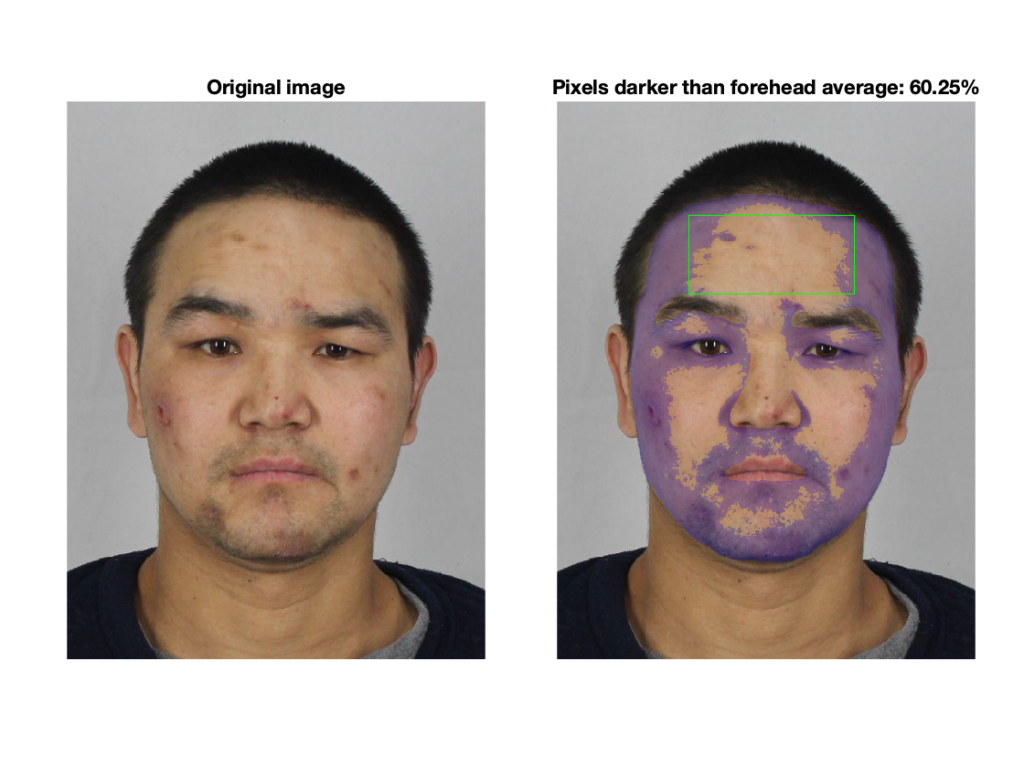
Repeating this computation for all 4600+ individuals, we were able to compare the differences in the P_D between detainees and non-detainees. To minimize additional biases that might result from age and gender, we analyzed men and women separately, and split each gender into three age groups (for a total of six groups for both detainees and non-detainees). Underage children (under 18) and the very elderly (over 80) were removed from the analysis, as people from these groups are very rarely detained.
The average P_D values for each group (presented as percentages) are shown in the plot below, together with their 95% confidence intervals:
As is seen in the plot, there are no statistically significant differences between the detainees and non-detainees in this regard, and the results of this study are therefore inconclusive as well. It may be that using more advanced tools and methods could lead to more precise and insightful conclusions, but our first pass and screening has suggested that systematic violence – using bruises as evidence – does not appear obvious from these particular photos.
Follow-up studies are, of course, welcome and encouraged.