
This short note reviews the documented number of children separated from their detained parents in Konasheher County, together with the differences in the nature and time of detention between fathers and mothers. The percentage of children with both/only parents detained is then extrapolated to the populations of children for all counties in the four southern Xinjiang prefectures (Aksu, Kashgar, Kizilsu, and Hotan) to obtain a conservative lower estimate on the total number of (mostly Uyghur) children separated from their parents in southern Xinjiang as of 2018.

One of the most important traits of the Xinjiang Police Files, first shared with the world in early 2022, is that they contain information for almost every registered resident of Kashgar’s Konasheher County, making it possible to do comprehensive reviews and studies for that county specifically. While sharing the police files, the source also combined almost everyone from Konasheher into a single master list (redacted version online, with an English translation also available) of over 275000 people, likely dating to late 2018 and believed to be nearly complete as this is close to the officially reported population of 284134 (suggesting light omissions and/or differences in reporting standards). As part of its documentation work over the past few years, the Xinjiang Victims Database has also worked with multiple other documents from Konasheher to identify a total of 21811 people from the master list who were in detention for at least some prolonged period in January 2017 or later. Because the documents analyzed have been relatively comprehensive, this number (21811) is believed to be a conservative but very close estimate of the total number of detainees in Konasheher, and is also close to what has been reported by researcher Adrian Zenz to the BBC (22762). Future documentation is likely to raise this number further, but probably not by much.
Since the compiled master list also specifies family relations and household numbers, we have been able to reconstruct how the detentions have affected each individual family, and to identify which households had both or only parents detained, in addition to identifying a total of 3772 children left behind (also a conservative lower estimate). Because many couples in the dominantly Uyghur southern Xinjiang often have three or more children, the consequences of having both parents taken into detention have been devastating, with the children usually sent to boarding schools, left in the care of grandparents or older siblings, or left to fend for themselves. With rare exceptions, we do not know the exact fates of these 3772 and cannot provide a clean breakdown of how common each outcome was. To err on the side of caution, we therefore use such general umbrella terms as “separated from parents” or “left behind”, and make no claims about specific outcomes. The exact family connections behind the numbers presented in this note are available in the relevant Excel file.
Of the 3772, a very small number lost their parents in the violent incident of December 15, 2013. We include them together with those whose parents were detained, but they could also be excluded without any real impact on the analysis here.
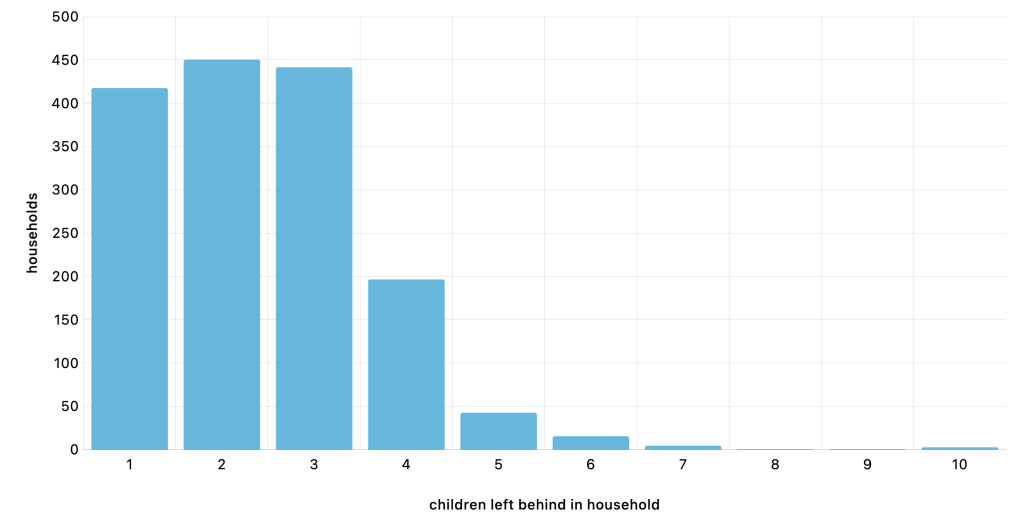
For the households where both/only parents were taken, an average of 2.4 children were left behind. Three or more children were left behind in over 700 families. The exact distribution is shown in the chart below:
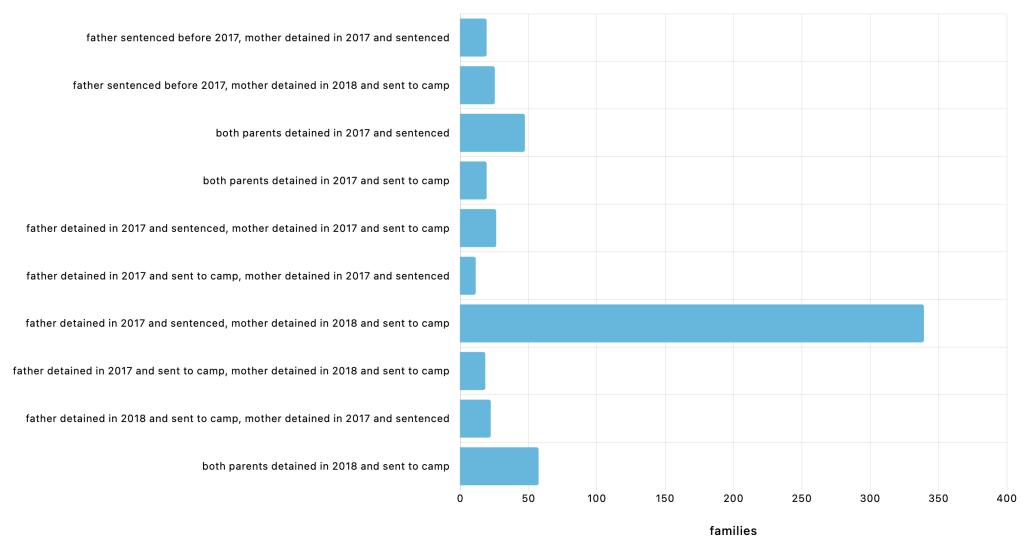
While documenting the detentions of their parents, we found that in the vast majority of cases, the father was detained first and the mother was detained later. The most common scenario by far (56% of families) was the father being given a long prison term in 2017 and the mother being sent to camp the following year. The chart below shows the relative frequency of the most common scenarios documented, for around 600 families where the detention times and types were clearly known:
Finally, the master list allows us to get a fairly accurate estimate of the percentage of minors in Konasheher who had both/only parents detained. As we are not aware of any documented cases of Han couples being detained with their underage children left behind, ethnic Han are excluded from this analysis. Because the latest date of birth on the master list is given as October 20, 2018, we use this as the approximate reference date for the list and count as a minor everyone born after October 20, 2000, which yields a total of 89274 non-Han minors. From this, we get that at least 4.22% (3772/89274) of the non-Han minors in Konasheher County had both/only parents detained.
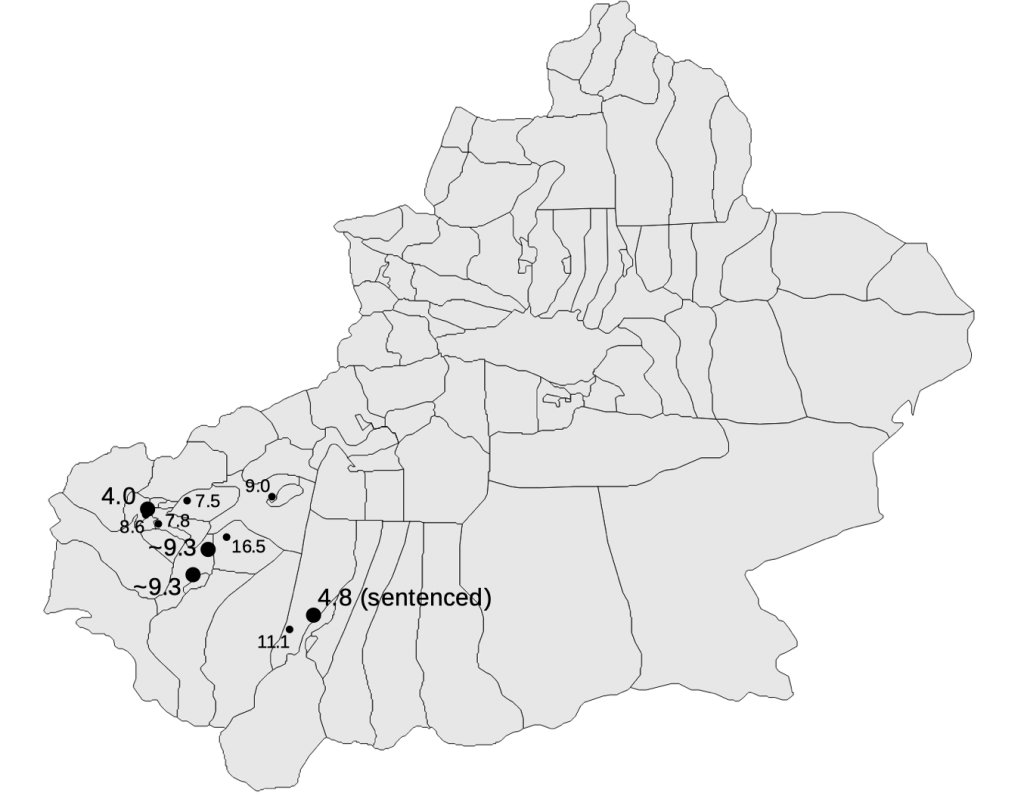
Because the detention trends across southern Xinjiang were very similar, with local detention rates consistently showing 5-15% of the total population in Uyghur-majority areas detained (figure above), it is reasonable to expect that the situation across the south was similar to that seen in Konasheher, allowing us to use the Konasheher percentage of children separated from parents (4.22%) to estimate the total number of children separated from parents across southern Xinjiang in general. (Statistically, the assumption here is that Konasheher County, as an Uyghur-majority county of nearly 300000, is representative of southern Xinjiang.)
To avoid over-extrapolating, we limit the domain to the four southern Xinjiang prefectures of Aksu, Kizilsu, Kashgar, and Hotan, which officially make up nearly 80% (9.2M) of Xinjiang’s Uyghur population and are frequently lumped together as the “four southern Xinjiang prefectures” (南疆四地州) in official rhetoric, with government statements identifying them as problematic because of poverty and “terrorism” (internal police reports from Urumqi also use the term “individuals from the four southern Xinjiang prefectures”, or 南疆四地州人员, to refer to people from there, while subjecting them to extra scrutiny). Because there is some evidence of the mass detention period lasting shorter in central and northern Xinjiang, with some reports in northern Xinjiang also suggesting one of two spouses being spared detention in order to look after the children, we do not consider it appropriate to use Konasheher for extrapolation to these regions given the evidence currently available.
To get the estimate, we just need to multiply 4.22% by the total non-Han minor population of southern Xinjiang, using the year 2018 as the reference. To the best of our knowledge, this number is not reported directly anywhere, but may be estimated from the total minor population and general ethnic composition county by county, both of which are available in the 2019 Xinjiang Statistical Yearbook. The procedure is outlined below:
- The populations of all minors, including ethnic Han, are available by county in Section 3-9.
- The ethnic compositions (non-Han % of the total population) can be obtained from Section 3-7.
- Multiplying these two gives an estimate of the population of non-Han children specifically. (This estimate is likely conservative and does not compromise our analysis, since non-Han are likely to dominate more among minors than among adults. For example, if the adults in some area are 50% Han, the children are very likely to be much less than 50% Han, given the effects of the one-child policy and a significant portion of Han in Xinjiang being migrants from inner China.)
- Further multiplying by the Konasheher percentage (4.22%) gives the estimate of children with both/only parents detained in each county.
The precise numbers are reported in the table below.
| county unit | non-Han % | minor population | non-Han minor population (est.) | minors separated from parents (est.) |
|---|---|---|---|---|
| Aksu City | 56.84 | 160569 | 91267 | 3851 |
| Onsu County | 76.15 | 76912 | 58568 | 2471 |
| Kucha County | 90.14 | 145364 | 131031 | 5529 |
| Shayar County | 86.87 | 77395 | 67233 | 2837 |
| Toqsu County | 94.36 | 64509 | 60870 | 2568 |
| Bay County | 89.31 | 68383 | 61072 | 2577 |
| Uchturpan County | 95.25 | 79477 | 75701 | 3194 |
| Awat County | 84.24 | 88060 | 74181 | 3130 |
| Kelpin County | 97.96 | 20288 | 19874 | 838 |
| Atush City | 92.73 | 103881 | 96328 | 4065 |
| Akto County | 96.64 | 87329 | 84394 | 3561 |
| Akchi County | 89.54 | 14456 | 12943 | 546 |
| Ulughchat County | 90.16 | 17934 | 16169 | 682 |
| Kashgar City | 86.54 | 220936 | 191198 | 8068 |
| Konasheher County | 98.26 | 98994 | 97271 | 4104 |
| Yengisheher County | 95.65 | 135371 | 129482 | 5464 |
| Yengisar County | 98.68 | 118229 | 116668 | 4923 |
| Poskam County | 86.04 | 70822 | 60935 | 2571 |
| Yarkand County | 97.2 | 343750 | 334125 | 14100 |
| Qaghiliq County | 96.15 | 202101 | 194320 | 8200 |
| Mekit County | 83.74 | 84900 | 71095 | 3000 |
| Yopurgha County | 94.98 | 62399 | 59266 | 2501 |
| Peyziwat County | 98.31 | 181240 | 178177 | 7519 |
| Maralbeshi County | 93.71 | 140284 | 131460 | 5547 |
| Tashkorgan Tajik Autonomous County | 93.43 | 12347 | 11535 | 486 |
| Hotan City | 91 | 166290 | 151323 | 6385 |
| Hotan County | 99.4 | 154436 | 153509 | 6478 |
| Qaraqash County | 97.69 | 263689 | 257597 | 10870 |
| Guma County | 98.98 | 121785 | 120542 | 5086 |
| Lop County | 98.48 | 119982 | 118158 | 4986 |
| Chira County | 98.28 | 55373 | 54420 | 2296 |
| Keriye County | 98.54 | 105269 | 103732 | 4377 |
| Niye County | 91.37 | 10852 | 9915 | 418 |
Tallying the final column gives the total estimate of at least 143228 children with both/only parents detained in southern Xinjiang.